Dilophosaurus
(die-LOH-foh-saw-rus)
| Quick Facts | |
|---|---|
| Name Meaning: | Two-crested Lizard |
| Distribution: | Arizona, USA; China |
| Time Period: | Early Jurassic, 201-189 Ma |
| Length: | 20 ft (6 m) |
| Weight: | 500 kg (½ ton) |
| Diet: | Small animals, perhaps fish |
| Habitat: | Near Rivers |
| Linnaean Classification | |
| Kingdom: | Animalia |
| Phylum: | Chordata |
| Class: | Sauropsida |
| Superorder: | Dinosauria |
| Order: | Saurischia |
| Suborder: | Theropoda |
| Family: | Coelophysidae |
| Genus: | Dilophosaurus |
| Cladistic Classification | |
| |
History
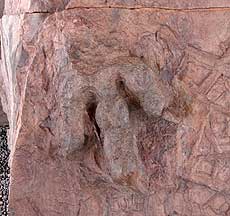 |
| Eubrontes track made by a dinosaur such as the Dilophosaurus. |
Description
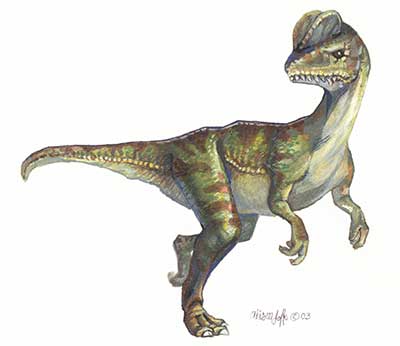
The Dilophosaurus was built lightweight, slender, and fast. It probably fed off of smaller animals, as it was not built to confront, kill, and eat larger prey. Its teeth were very long, but had a small base and its mouth was not built well to consume larger animals. The dinosaur sported a large double crest on the head, hence the name. The dinosaur had a peculiar notch behind its first row of teeth making it look like a crocodile. This notch was due to a weak connection in the bones of the skull.Lifestyle
The most distinguishing feature of the Dilophosaurus is the pair of crests on its head. These crests were very fragile and were probably used for display or to signal others. Not all Dilophosaurus had a crest. It may have been a feature limited to the males. Several specimens were found together, suggesting that it may have hunt in packs. Many paleontologists, because of this notch, have believed that the Dilophosaurus was a scavenger of dead carcasses as the weak link would not be strong enough to handle large moving prey. It may have also been good at hunting small animals as the notch would have provided a excellent way of reaching smaller spaces.Misconceptions
The Dilophosaurus was shown in the popular film Jurassic Park as a much different dinosaur than it really is. It was presented as much smaller than its actual size, it spits poison to blind its enemies, and uses a large neck frill to intimidate. There is not actual evidence to support the poison or neck frill and it was clearly larger than portrayed.
ScienceViews Writer: Jason Hamilton.
Copyright © 2005-2008 Calvin & Rosanna Hamilton. All rights reserved.